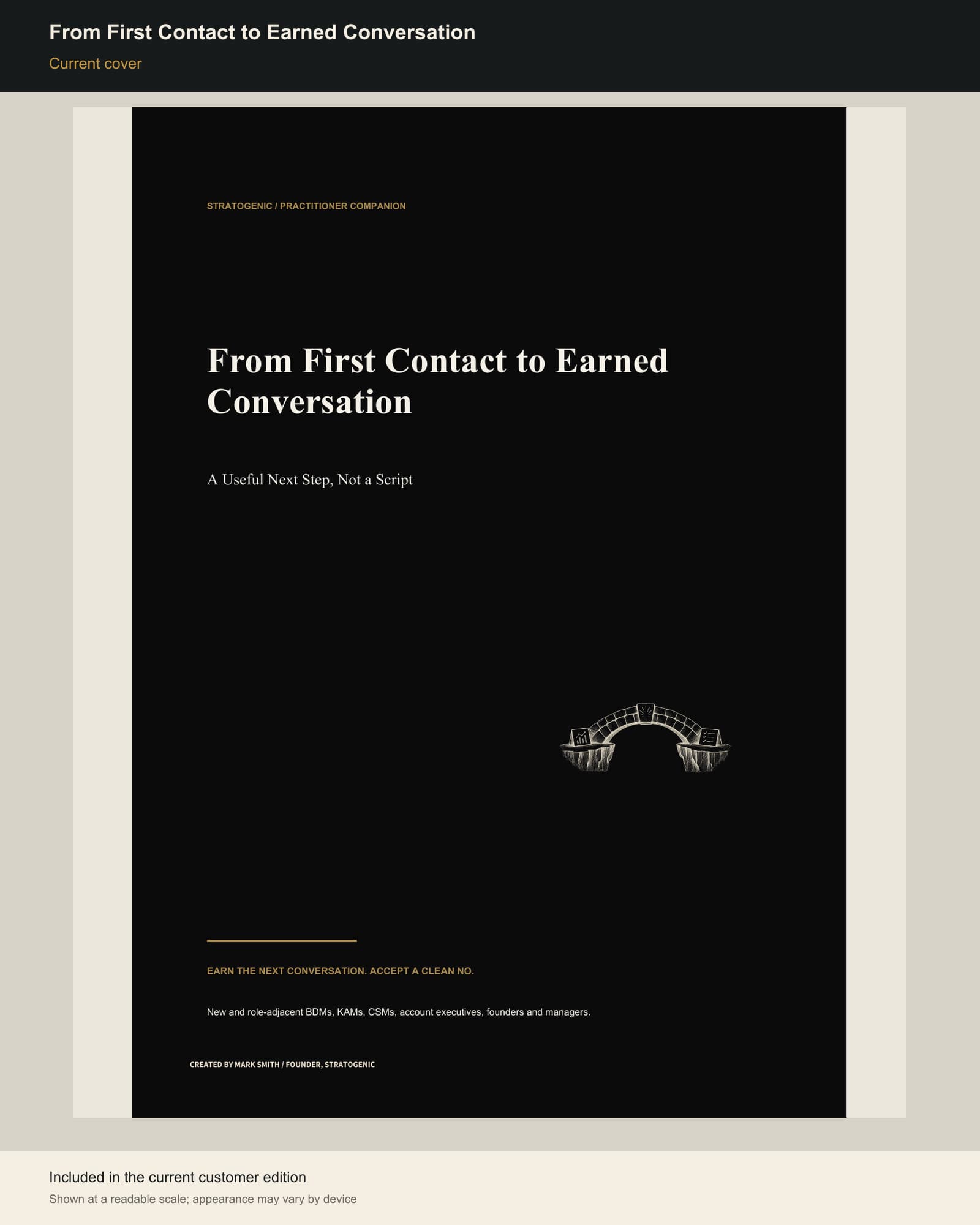
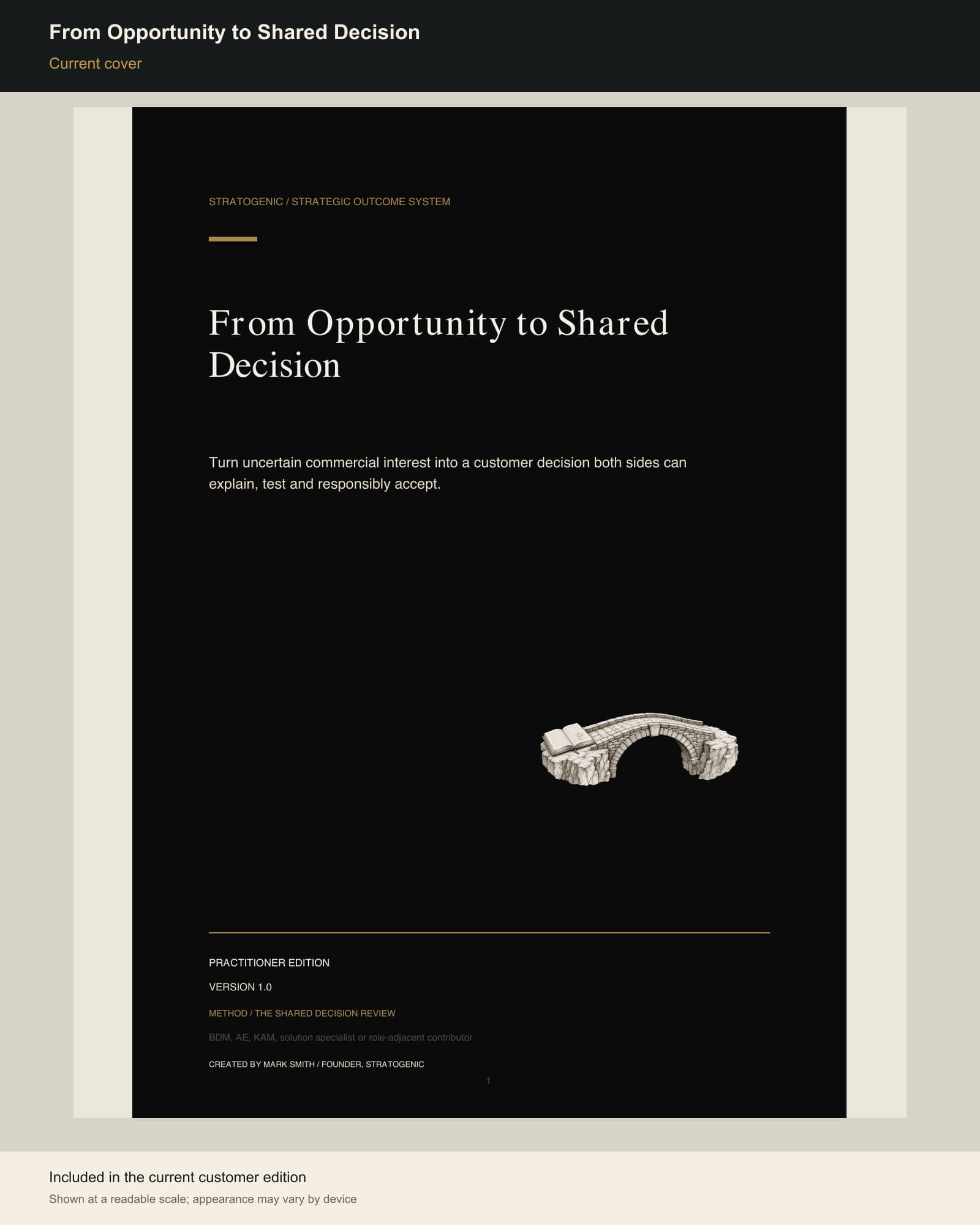
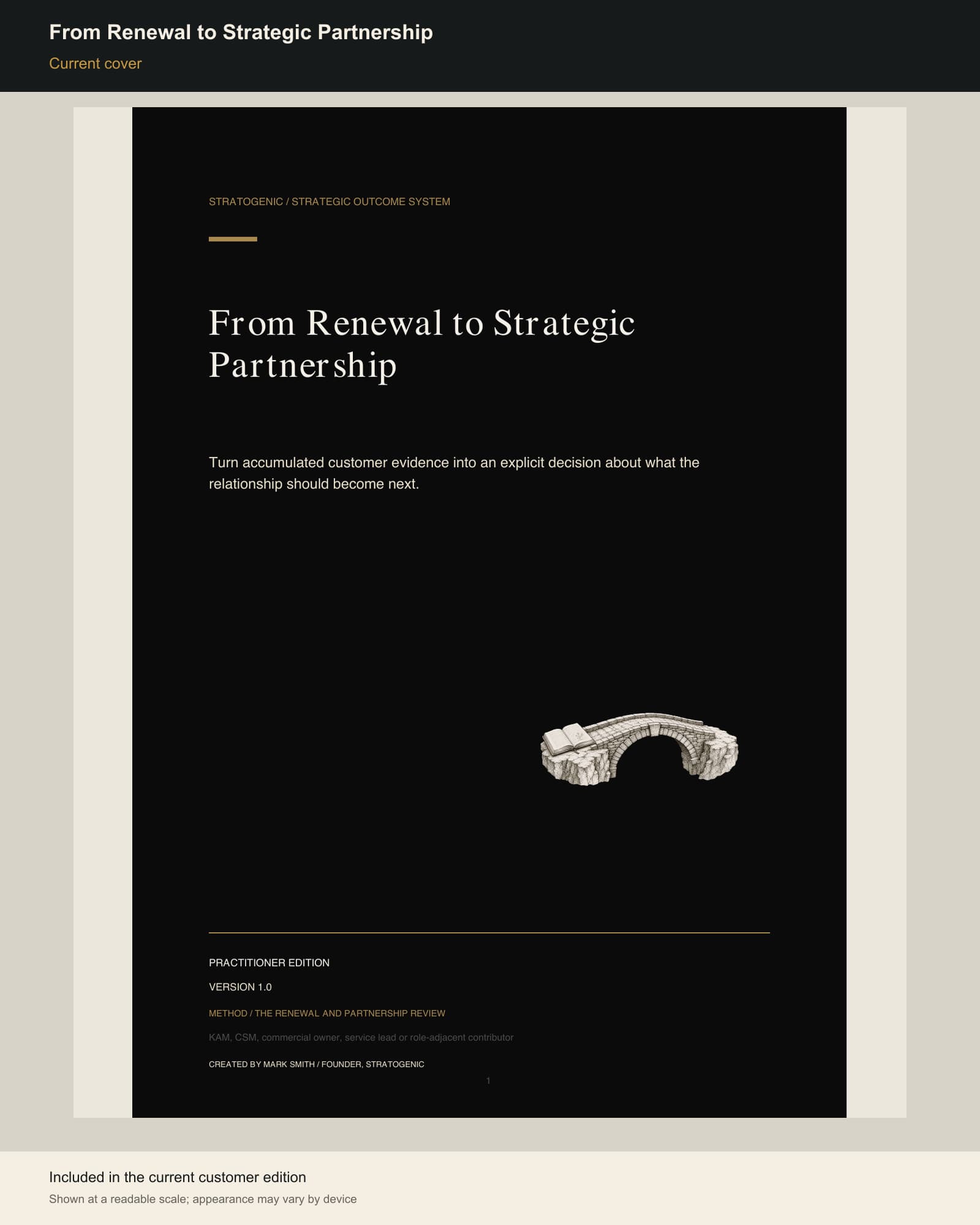
Take a Look Inside
Open a focused preview of the supplied pages, sheets or working views.
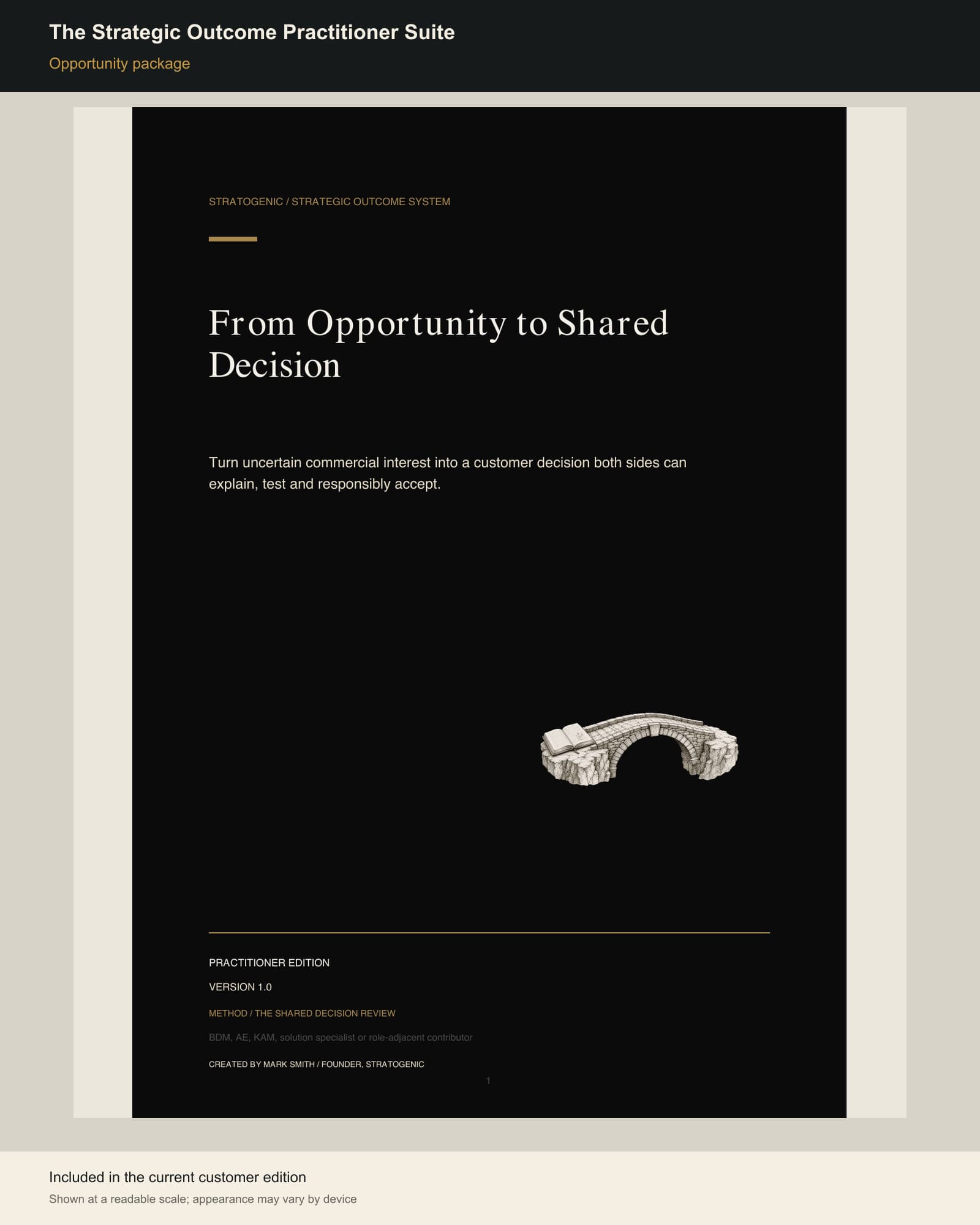
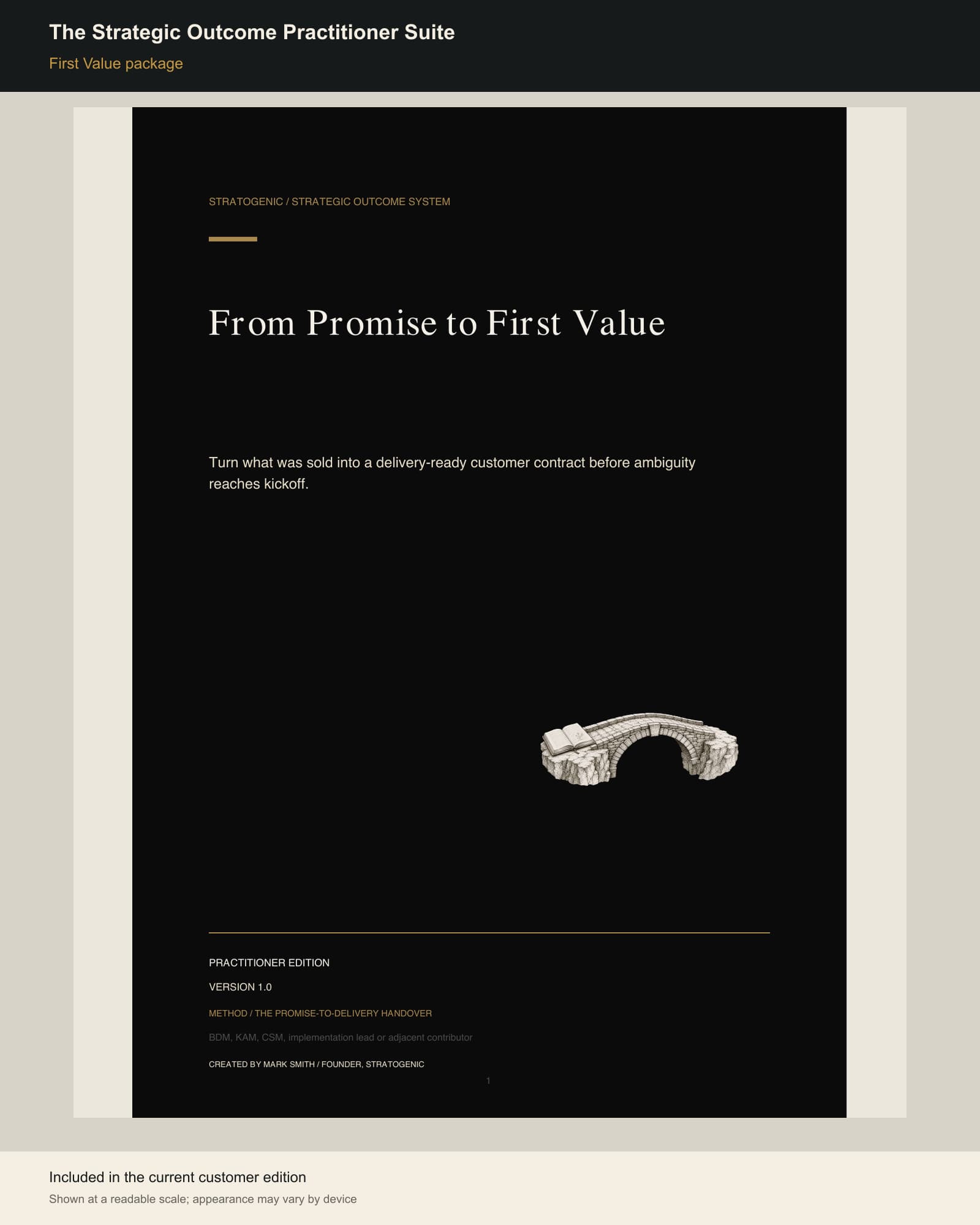
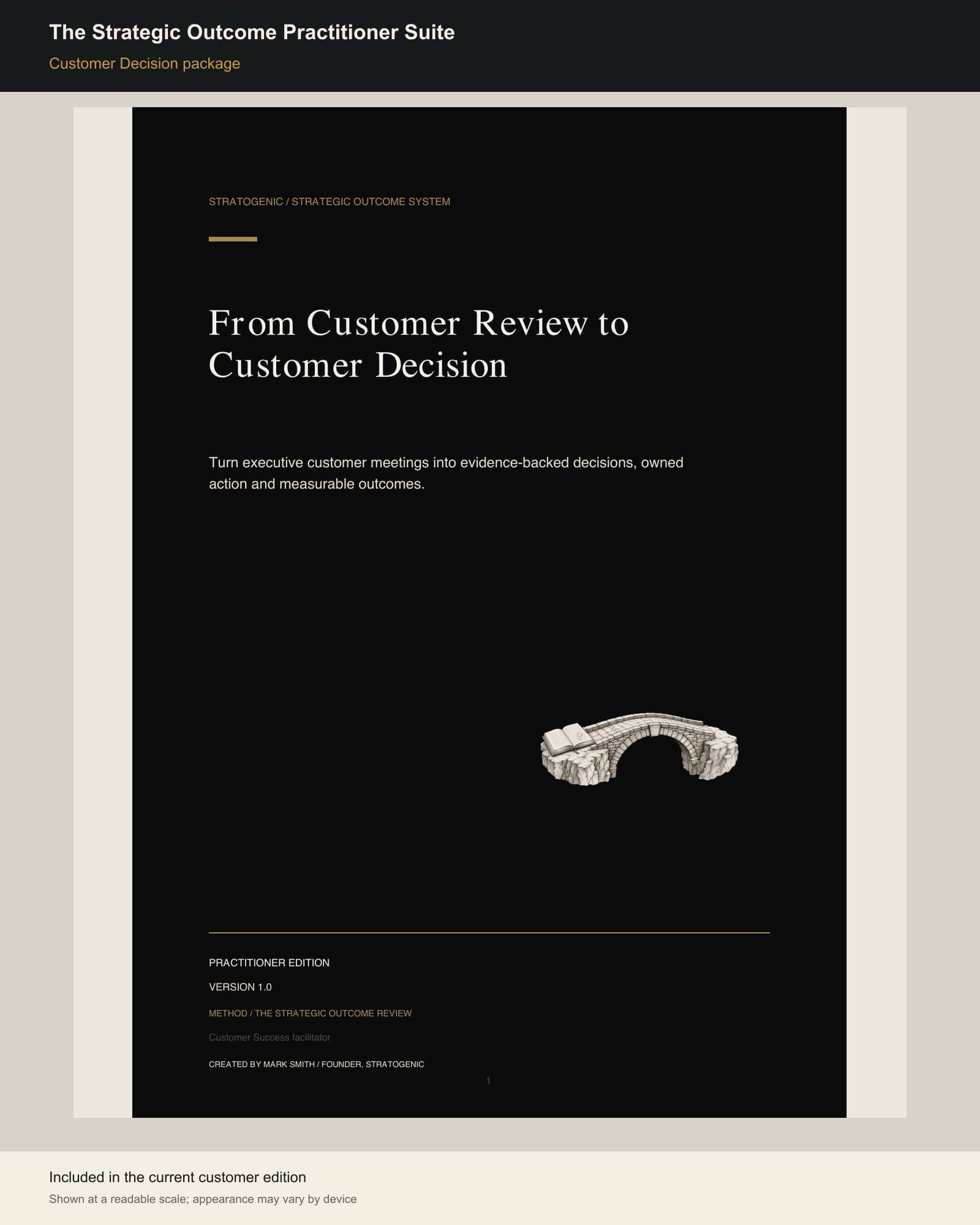
Six complete packages with guides, workbooks, scripts, decks and print-ready tools.
What It Is For
Equip commercial and customer teams with six connected methods for first contact, shared decisions, handover, customer review, controlled recovery, and renewal.
Intended for: Commercial and customer teams that need one consistent operating system from first contact through renewal, including the escalation exception lane.
What Exists Behind This Page
This preview is tied to the built edition and its recorded release state. It is not a promise that the product is already available or that using it guarantees the outcome.
- five complete customer-decision packages
- first-contact companion
- editable workbooks, workshop decks and operator guides
- fillable and print-ready working tools
- further reading and evidence position in every package
- 2 prepared editions
- 3 inspectable customer-page previews
- 15 named sources with stated use and transfer limits
Three Decisions It Helps You Make
- 01
Is there enough evidence of a relevant customer problem to earn a second conversation?
- 02
Can the customer outcome, evidence, alternatives and decision owners be read back and corrected by both sides?
- 03
Which promise, owner, dependency and first-value test must survive the handover?
Price and Package
What this edition does not promise
- A working aid, not a guarantee of a commercial, career or personal outcome.
- It does not replace legal, regulatory, clinical, financial or employer-specific advice.
- Human release review and fulfilment testing remain required.
Source Corpus Acknowledged
Named research, standards and official guidance inform selected distinctions and design choices. They do not endorse or independently validate this Stratogenic product.
15 named sources and transfer limits
- Rousseau, D. M. (2006). Is There Such a Thing as Evidence-Based Management? Academy of Management Review, 31(2). — Supports combining the best available evidence with professional judgement rather than treating a framework as proof. Limit: This source informs an underlying practice; it does not independently validate the Stratogenic product or guarantee an outcome.
- Edmondson, A. C. (1999). Psychological Safety and Learning Behavior in Work Teams. Administrative Science Quarterly, 44(2), 350-383. — Relevant to surfacing uncertainty, error and dissent without turning the facilitator into the decision maker. Limit: This source informs an underlying practice; it does not independently validate the Stratogenic product or guarantee an outcome.
- Gollwitzer, P. M. (1999). Implementation Intentions: Strong Effects of Simple Plans. American Psychologist, 54(7), 493-503. — Informs specific owners, triggers and observable follow-through conditions. Limit: This source informs an underlying practice; it does not independently validate the Stratogenic product or guarantee an outcome.
- Klein, G. (2007). Performing a Project Premortem. Harvard Business Review. — Supports making plausible failure conditions and informed concerns discussable before commitment. Limit: This source informs an underlying practice; it does not independently validate the Stratogenic product or guarantee an outcome.
- Kaplan, R. S., & Norton, D. P. (1992). The Balanced Scorecard - Measures That Drive Performance. Harvard Business Review. — Informs the separation of outcome measures, performance drivers and learning rather than relying on activity alone. Limit: This source informs an underlying practice; it does not independently validate the Stratogenic product or guarantee an outcome.
- Shostack, G. L. (1984). Designing Services That Deliver. Harvard Business Review. — Informs the explicit transfer of front-stage promises, backstage dependencies and failure points. Limit: This source informs an underlying practice; it does not independently validate the Stratogenic product or guarantee an outcome.
- Rousseau, D. M. (1989). Psychological and Implied Contracts in Organizations. Employee Responsibilities and Rights Journal, 2, 121-139. — Provides a research basis for distinguishing formal obligations from interpreted or implied expectations. Limit: This source informs an underlying practice; it does not independently validate the Stratogenic product or guarantee an outcome.
- International Organization for Standardization. (2018). ISO 10002:2018 - Quality management: Customer satisfaction - Guidelines for complaints handling in organizations. — Provides established guidance covering openness, complainant needs, resolution, analysis and improvement. Limit: This source informs an underlying practice; it does not independently validate the Stratogenic product or guarantee an outcome.
- Tax, S. S., Brown, S. W., & Chandrashekaran, M. (1998). Customer Evaluations of Service Complaint Experiences. Journal of Marketing, 62(2), 60-76. — Shows that customers evaluate outcomes, procedures and interpersonal treatment in complaint experiences. Limit: This source informs an underlying practice; it does not independently validate the Stratogenic product or guarantee an outcome.
- Smith, A. K., Bolton, R. N., & Wagner, J. (1999). A Model of Customer Satisfaction with Service Encounters Involving Failure and Recovery. Journal of Marketing Research, 36(3), 356-372. — Provides empirical grounding for making recovery proportionate to the type and magnitude of a service failure. Limit: This source informs an underlying practice; it does not independently validate the Stratogenic product or guarantee an outcome.
- Webster, F. E., Jr., & Wind, Y. (1972). A General Model for Understanding Organizational Buying Behavior. Journal of Marketing, 36(2), 12-19. — Supports treating a complex opportunity as an organisational decision involving multiple actors, goals and constraints rather than a single-contact persuasion exercise. Limit: This source informs an underlying practice; it does not independently validate the Stratogenic product or guarantee an outcome.
- Anderson, J. C., Jain, D. C., & Chintagunta, P. K. (1992). Customer Value Assessment in Business Markets: A State-of-Practice Study. Journal of Business-to-Business Marketing, 1(1), 3-29. — Informs disciplined value evidence and the distinction between an attractive claim and a customer-defensible business case. Limit: This source informs an underlying practice; it does not independently validate the Stratogenic product or guarantee an outcome.
- Morgan, R. M., & Hunt, S. D. (1994). The Commitment-Trust Theory of Relationship Marketing. Journal of Marketing, 58(3), 20-38. — Provides a research basis for treating trust and commitment as relationship conditions rather than assuming that renewal creates a partnership. Limit: This source informs an underlying practice; it does not independently validate the Stratogenic product or guarantee an outcome.
- Vargo, S. L., & Lusch, R. F. (2004). Evolving to a New Dominant Logic for Marketing. Journal of Marketing, 68(1), 1-17. — Supports focusing the future relationship on value created through use and mutual contribution, not supplier activity alone. Limit: This source informs an underlying practice; it does not independently validate the Stratogenic product or guarantee an outcome.
- Workman, J. P., Jr., Homburg, C., & Jensen, O. (2003). Intraorganizational Determinants of Key Account Management Effectiveness. Journal of the Academy of Marketing Science, 31(1), 3-21. — Informs the need for cross-functional resources, proactive activity and senior involvement around strategically important relationships. Limit: This source informs an underlying practice; it does not independently validate the Stratogenic product or guarantee an outcome.
Corpus review: 2026-07-19. Provider documentation is operational guidance, not independent validation or endorsement.
Frequently Asked Questions
What is The Strategic Outcome Practitioner Suite?
The Strategic Outcome Practitioner Suite is complete commercial system designed to help commercial and customer teams that need one consistent operating system from first contact through renewal, including the escalation exception lane. equip commercial and customer teams with six connected methods for first contact, shared decisions, handover, customer review, controlled recovery, and renewal.
What do I receive with The Strategic Outcome Practitioner Suite?
Six complete packages with guides, workbooks, scripts, decks and print-ready tools.
Can I buy or download The Strategic Outcome Practitioner Suite now?
No. This is a forthcoming preview. Checkout and delivery stay disabled until named human approval and fulfilment checks are recorded.