Take a Look Inside
Open a focused preview of the supplied pages, sheets or working views.
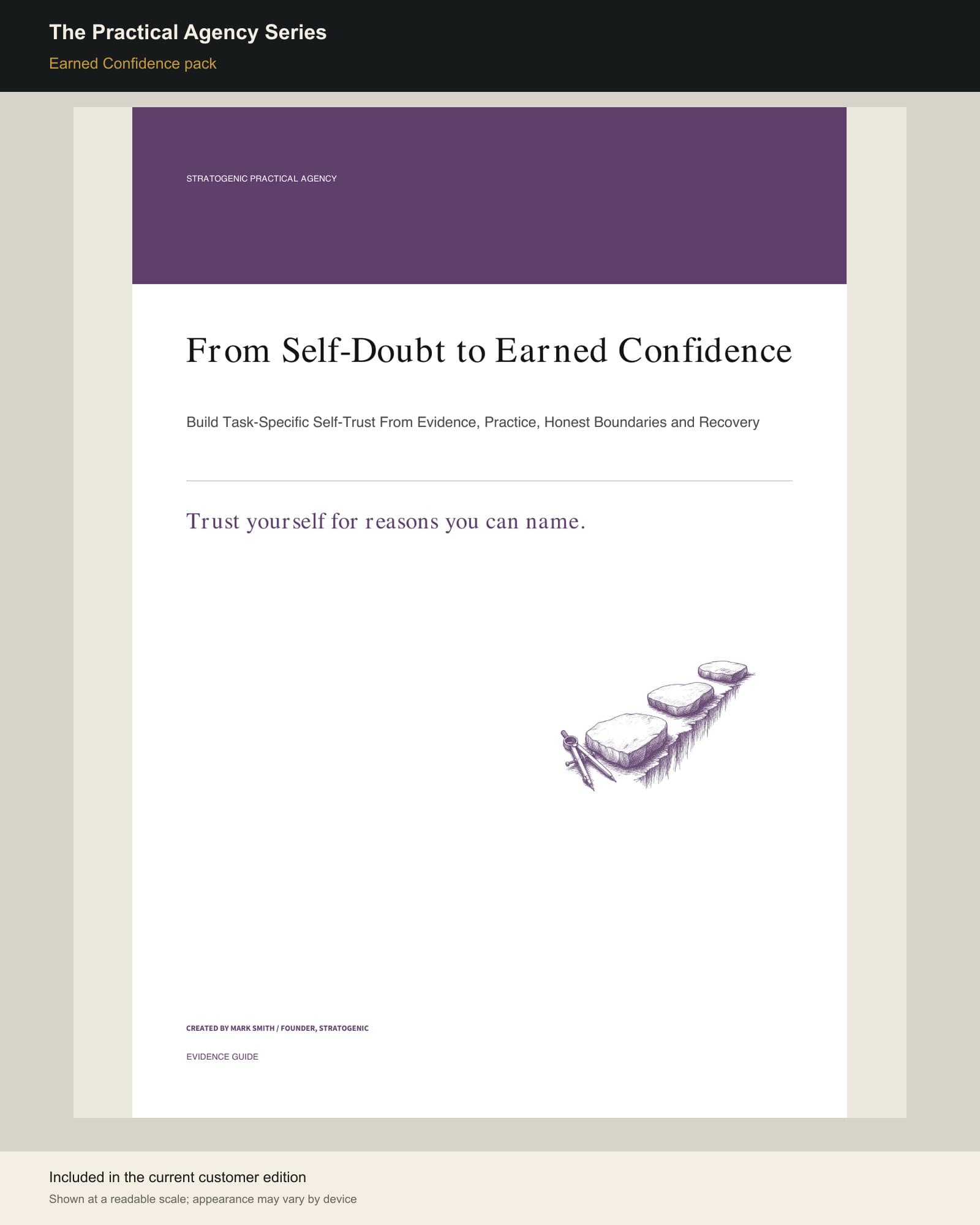
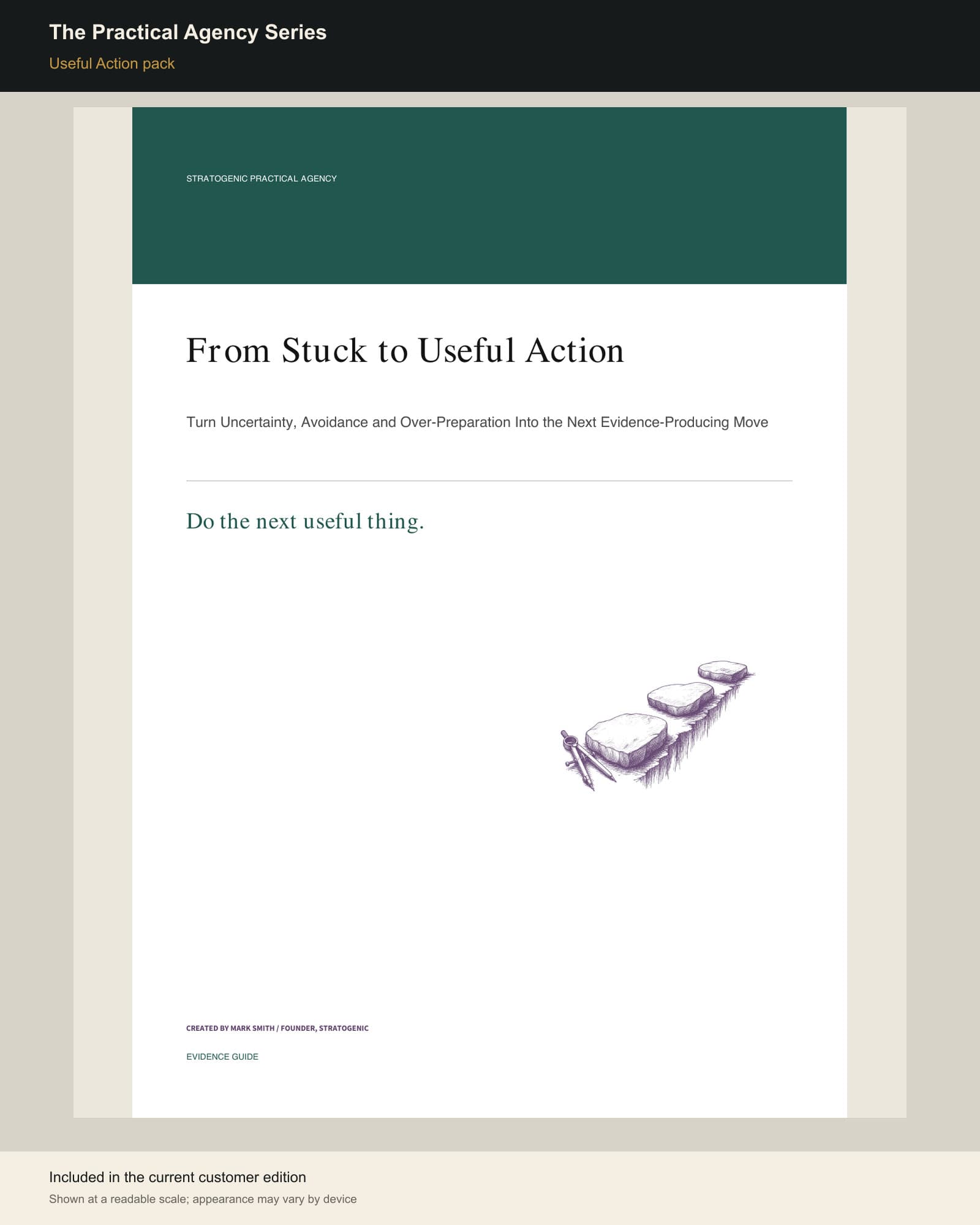
Three complete packs with research guides, workbooks and A5/A6 live-use tools.
What It Is For
Use three connected, evidence-bounded methods to calibrate judgement, take a useful reality-facing action and sustain direction towards meaningful movement.
Intended for: New founders, first-time operators, independent workers and role changers building a practical personal operating system.
What Exists Behind This Page
This preview is tied to the built edition and its recorded release state. It is not a promise that the product is already available or that using it guarantees the outcome.
- 2 prepared editions
- 3 inspectable customer-page previews
- 24 named sources with stated use and transfer limits
Three Decisions It Helps You Make
- 01
What observable evidence would justify confidence in this specific situation?
- 02
What is unclear enough to block one useful next action?
- 03
Is the problem too many possible directions or no evidence for choosing among them?
Price and Package
What this edition does not promise
- A working aid, not a guarantee of a commercial, career or personal outcome.
- It does not replace legal, regulatory, clinical, financial or employer-specific advice.
- Human release review and fulfilment testing remain required.
Source Corpus Acknowledged
Named research, standards and official guidance inform selected distinctions and design choices. They do not endorse or independently validate this Stratogenic product.
24 named sources and transfer limits
- Aristotle, Nicomachean Ethics, Books II and III. — Place courage between avoidance and rashness. Limit: A philosophical model, not a measure of confidence.
- Epictetus, Enchiridion, section 1. — Separate one's actions and judgements from outcomes and reputation. Limit: An ethical argument, not an experimental finding; 'up to us' is a responsibility boundary, not total control.
- Bandura (1977), Self-Efficacy: Toward a Unifying Theory of Behavioral Change. — Build task-specific confidence through mastery, modelling, credible persuasion and interpretation of state. Limit: Self-efficacy is task-specific and is not self-esteem.
- APA (2025), Self-efficacy: The Theory at the Heart of Human Agency. — Translate the four efficacy sources for general readers. Limit: A research summary, not a systematic review.
- Bol et al. (2012), Calibration Research: Where Do We Go From Here? — Compare predicted confidence with performance and update. Limit: Much evidence concerns learning tasks, not open-ended founder decisions.
- Breines and Chen (2012), Self-Compassion Increases Self-Improvement Motivation. — Respond to failure accurately without using self-attack as motivation. Limit: Short experiments do not establish long-term change.
- Pittig et al. (2023), Change of Threat Expectancy in Exposure-Based Psychotherapy. — Record a safe prediction, act, observe and deliberately update. Limit: Only low-stakes tests; this is not exposure therapy or self-treatment.
- Macri and Rogge (2024), Psychological Flexibility and Inflexibility as ACT Mechanisms. — Support values-consistent action without waiting for discomfort to disappear. Limit: This is a non-clinical transfer, not ACT or therapy.
- Newman et al. (2019), Entrepreneurial Self-Efficacy: A Systematic Review. — Tie founder confidence to specific tasks and self-regulation. Limit: Measures vary; raising confidence alone is not proven to improve a venture.
- Aristotle, Nicomachean Ethics, Books II, III and VI. — Treat practical excellence as trained activity and choice. Limit: Ancient virtue ethics informs questions but does not validate this workbook.
- Gollwitzer and Sheeran (2006), Implementation Intentions and Goal Achievement. — Pre-decide when, where and how a response begins. Limit: Effects vary; a plan cannot repair an unsafe, unwanted or structurally blocked goal.
- Wang et al. (2021), Mental Contrasting With Implementation Intentions. — Contrast the desired outcome with the real internal obstacle. Limit: Average effects are modest and heterogeneous.
- Steel (2007), The Nature of Procrastination. — Diagnose delay through expectancy, aversiveness, impulsiveness and delayed reward. Limit: Correlations do not establish one cause for an individual.
- Campos et al. (2017), Teaching Personal Initiative Beats Traditional Training. — Frame initiative as self-starting, future-oriented and persistent behaviour. Limit: An intensive Togo programme; its profit result cannot be transferred to this self-guided product.
- Brockhuis et al. (2025), A Meta-Analytic Review and Conceptual Model of Goal Adjustment in Response to Striving Difficulties. — Make continue, reshape, pause, stop and re-engage legitimate evidence-led routes. Limit: Evidence quality was low-to-moderate with high heterogeneity; disengagement is not automatically beneficial.
- Stein et al. (2023), Individual Behavioral Activation: A Meta-analysis. — Recognise how avoidance narrows contact with information and reinforcement. Limit: No treatment claim; marked distress or impairment warrants qualified support.
- Aristotle, Nicomachean Ethics, Book I. — Ask which end an activity serves instead of treating activity as its own justification. Limit: Ancient virtue ethics informs the question; it does not establish a modern productivity effect.
- Sheldon and Elliot (1999), Goal Striving, Need Satisfaction, and Longitudinal Well-Being. — Test whether a goal fits the person's developing interests and values before intensifying effort. Limit: Self-concordance is not a licence to ignore obligations, affected people or material constraints.
- Kurzban et al. (2013), An Opportunity Cost Model of Subjective Effort and Task Performance. — Treat attention to one task as displacement of other possible uses, not as a freely expandable resource. Limit: A theoretical model and debate article; it does not calculate an individual's correct priority.
- Leroy (2009), Why Is It So Hard to Do My Work? The Challenge of Attention Residue. — Use a deliberate closing or parking record before switching unfinished work. Limit: Laboratory and workplace studies do not prove that all switching is harmful or avoidable.
- Shah, Friedman and Kruglanski (2002), Forgetting All Else: Antecedents and Consequences of Goal Shielding. — Protect a focal goal from unrelated alternatives while retaining explicit exception conditions. Limit: Goal shielding can hide better options; commitment is not evidence that a goal remains worthwhile.
- Monsell (2003), Task Switching. — Reduce avoidable switching and create a re-entry cue when switching is necessary. Limit: Evidence often uses simple cognitive tasks; it should not be converted into a universal ban on varied work.
- Harkin et al. (2016), Does Monitoring Goal Progress Promote Goal Attainment? — Record a small number of progress signals and use them to change the next decision. Limit: Average effects vary by context; recording a metric can distort work when the metric is a poor proxy.
- Masicampo and Baumeister (2011), Consider It Done! Plan Making Can Eliminate the Cognitive Effects of Unfulfilled Goals. — Park non-focal commitments with a credible next step so they do not remain vague open loops. Limit: A plan can reduce cognitive interference without producing completion; plans still require execution and review.
Corpus review: 2026-07-19. Provider documentation is operational guidance, not independent validation or endorsement.
Frequently Asked Questions
What is The Practical Agency Series?
The Practical Agency Series is complete development series designed to help new founders, first-time operators, independent workers and role changers building a practical personal operating system. use three connected, evidence-bounded methods to calibrate judgement, take a useful reality-facing action and sustain direction towards meaningful movement.
What do I receive with The Practical Agency Series?
Three complete packs with research guides, workbooks and A5/A6 live-use tools.
Can I buy or download The Practical Agency Series now?
No. This is a forthcoming preview. Checkout and delivery stay disabled until named human approval and fulfilment checks are recorded.