Take a Look Inside
Open a focused preview of the supplied pages, sheets or working views.
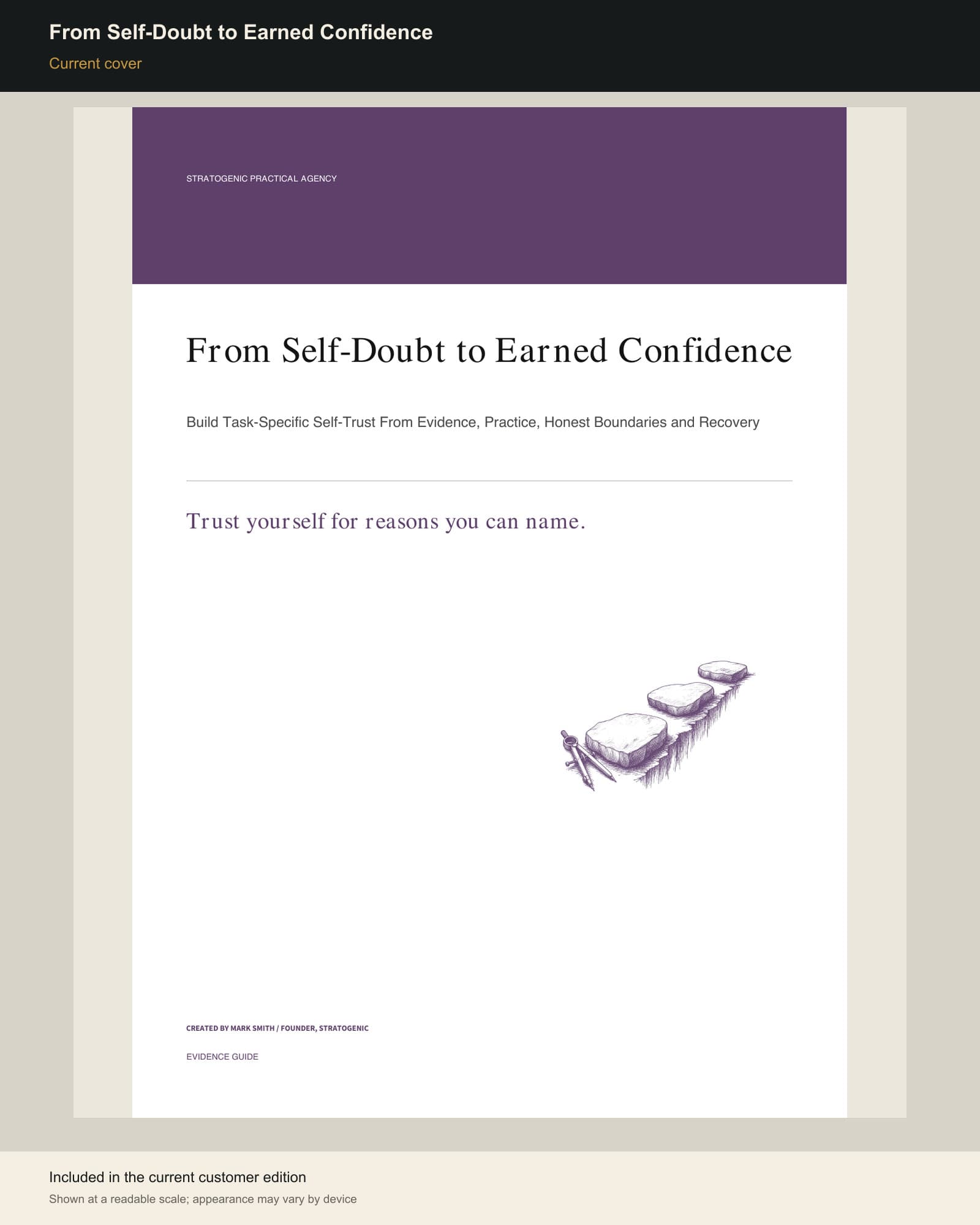
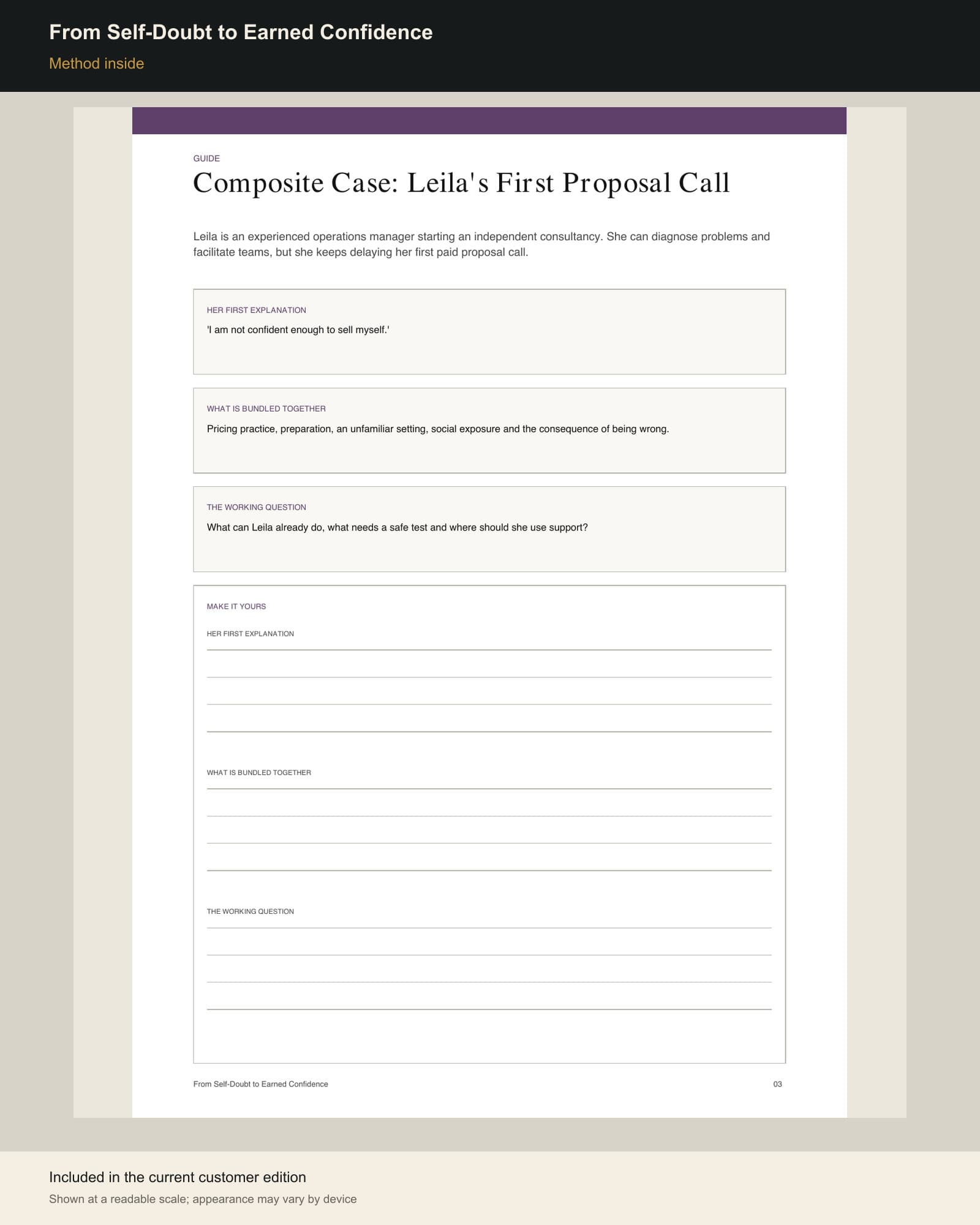
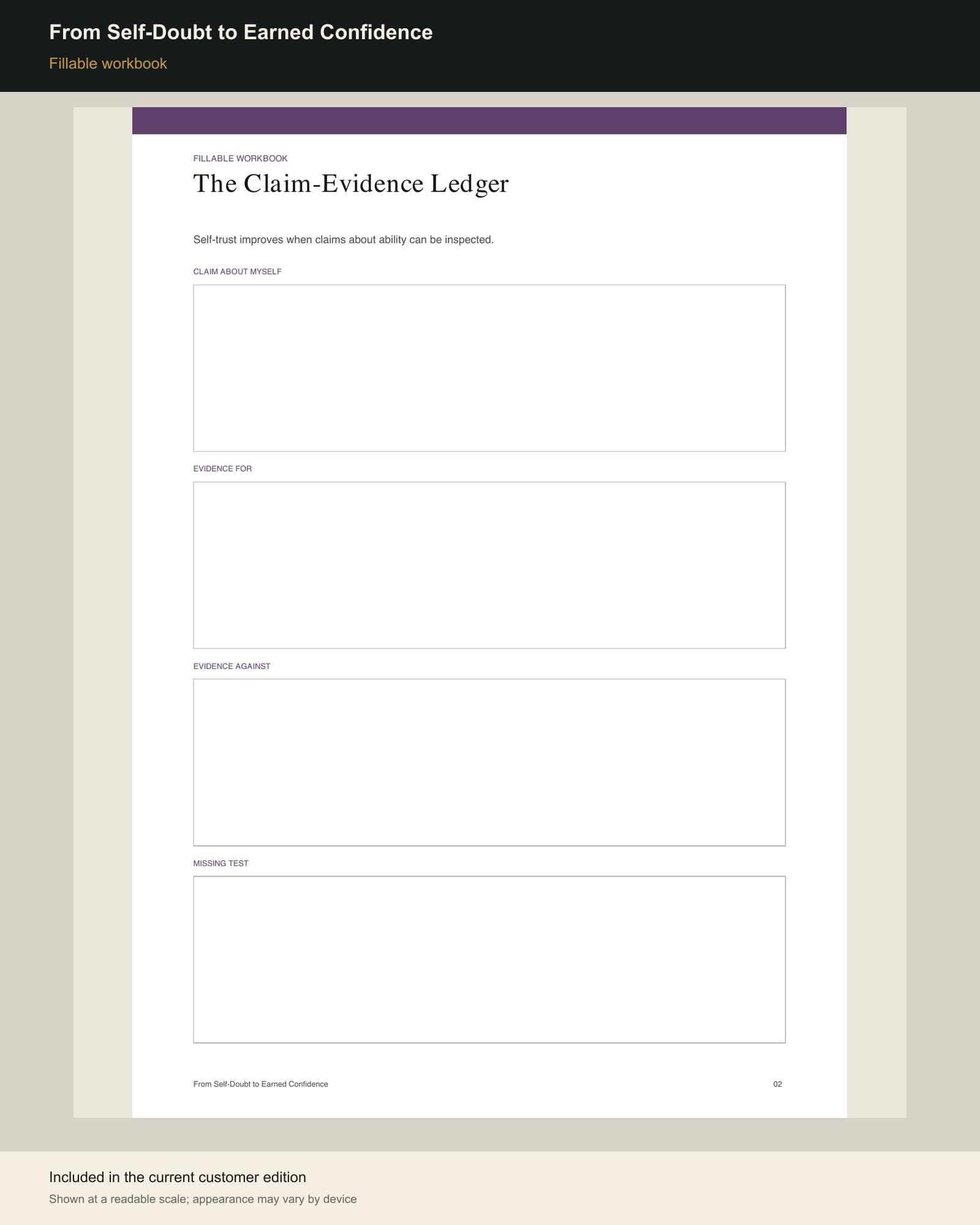
Research guide, physical and fillable workbooks, A5 session pad and A6 phone-side pad.
What It Is For
Replace global self-doubt with a task-specific judgement grounded in evidence, safe practice, competence boundaries and recovery.
Intended for: New founders, first-time operators, role changers and people taking on visible or unfamiliar work.
What Exists Behind This Page
This preview is tied to the built edition and its recorded release state. It is not a promise that the product is already available or that using it guarantees the outcome.
- 3 prepared editions
- 3 inspectable customer-page previews
- 9 named sources with stated use and transfer limits
Three Decisions It Helps You Make
- 01
What observable evidence would justify confidence in this specific situation?
- 02
Which bounded practice would reveal whether the skill is improving?
- 03
Does this need a working aid, human feedback or qualified support?
Price and Package
What this edition does not promise
- A working aid, not a guarantee of a commercial, career or personal outcome.
- It does not replace legal, regulatory, clinical, financial or employer-specific advice.
- Human release review and fulfilment testing remain required.
Source Corpus Acknowledged
Named research, standards and official guidance inform selected distinctions and design choices. They do not endorse or independently validate this Stratogenic product.
9 named sources and transfer limits
- Aristotle, Nicomachean Ethics, Books II and III. — Place courage between avoidance and rashness. Limit: A philosophical model, not a measure of confidence.
- Epictetus, Enchiridion. — Examine an impression before treating it as a complete account of danger or ability. Limit: A reflection prompt, not evidence that thoughts can be chosen away.
- Bandura (1977), Self-Efficacy: Toward a Unifying Theory of Behavioral Change. — Build task-specific confidence through mastery, modelling, credible persuasion and interpretation of state. Limit: Self-efficacy is task-specific and is not self-esteem.
- APA (2025), Self-efficacy: The Theory at the Heart of Human Agency. — Translate the four efficacy sources for general readers. Limit: A research summary, not a systematic review.
- Bol et al. (2012), Calibration Research: Where Do We Go From Here? — Compare predicted confidence with performance and update. Limit: Much evidence concerns learning tasks, not open-ended founder decisions.
- Breines and Chen (2012), Self-Compassion Increases Self-Improvement Motivation. — Respond to failure accurately without using self-attack as motivation. Limit: Short experiments do not establish long-term change.
- Pittig et al. (2023), Change of Threat Expectancy in Exposure-Based Psychotherapy. — Record a safe prediction, act, observe and deliberately update. Limit: Only low-stakes tests; this is not exposure therapy or self-treatment.
- Macri and Rogge (2024), Psychological Flexibility and Inflexibility as ACT Mechanisms. — Act with doubt present when the action is safe and values-consistent. Limit: A non-clinical transfer, not therapy.
- Newman et al. (2019), Entrepreneurial Self-Efficacy: A Systematic Review. — Tie founder confidence to specific tasks and self-regulation. Limit: Measures vary; raising confidence alone is not proven to improve a venture.
Corpus review: 2026-07-19. Provider documentation is operational guidance, not independent validation or endorsement.
Frequently Asked Questions
What is From Self-Doubt to Earned Confidence?
From Self-Doubt to Earned Confidence is development pack designed to help new founders, first-time operators, role changers and people taking on visible or unfamiliar work. replace global self-doubt with a task-specific judgement grounded in evidence, safe practice, competence boundaries and recovery.
What do I receive with From Self-Doubt to Earned Confidence?
Research guide, physical and fillable workbooks, A5 session pad and A6 phone-side pad.
Can I buy or download From Self-Doubt to Earned Confidence now?
No. This is a forthcoming preview. Checkout and delivery stay disabled until named human approval and fulfilment checks are recorded.