Take a Look Inside
Open a focused preview of the supplied pages, sheets or working views.
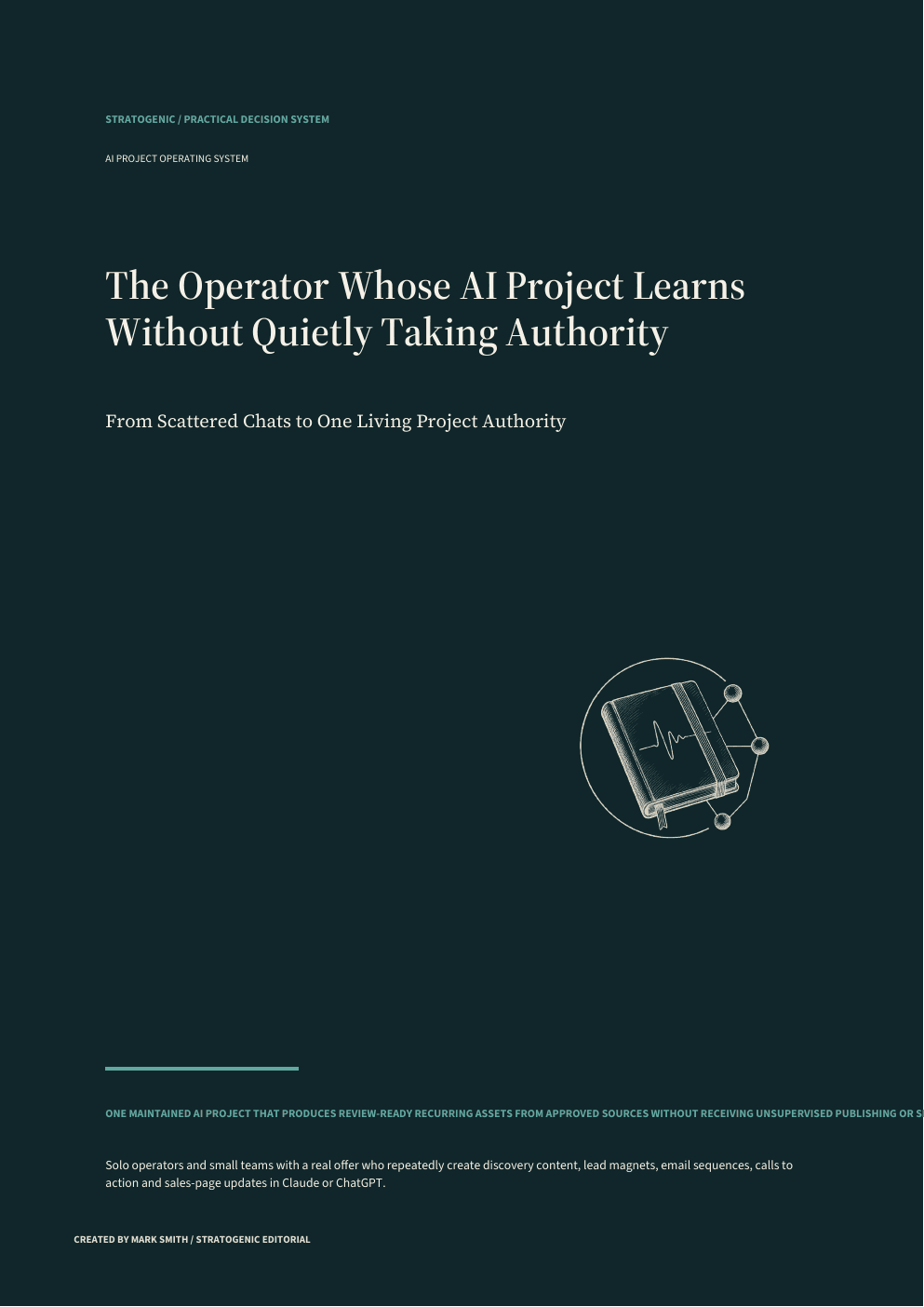
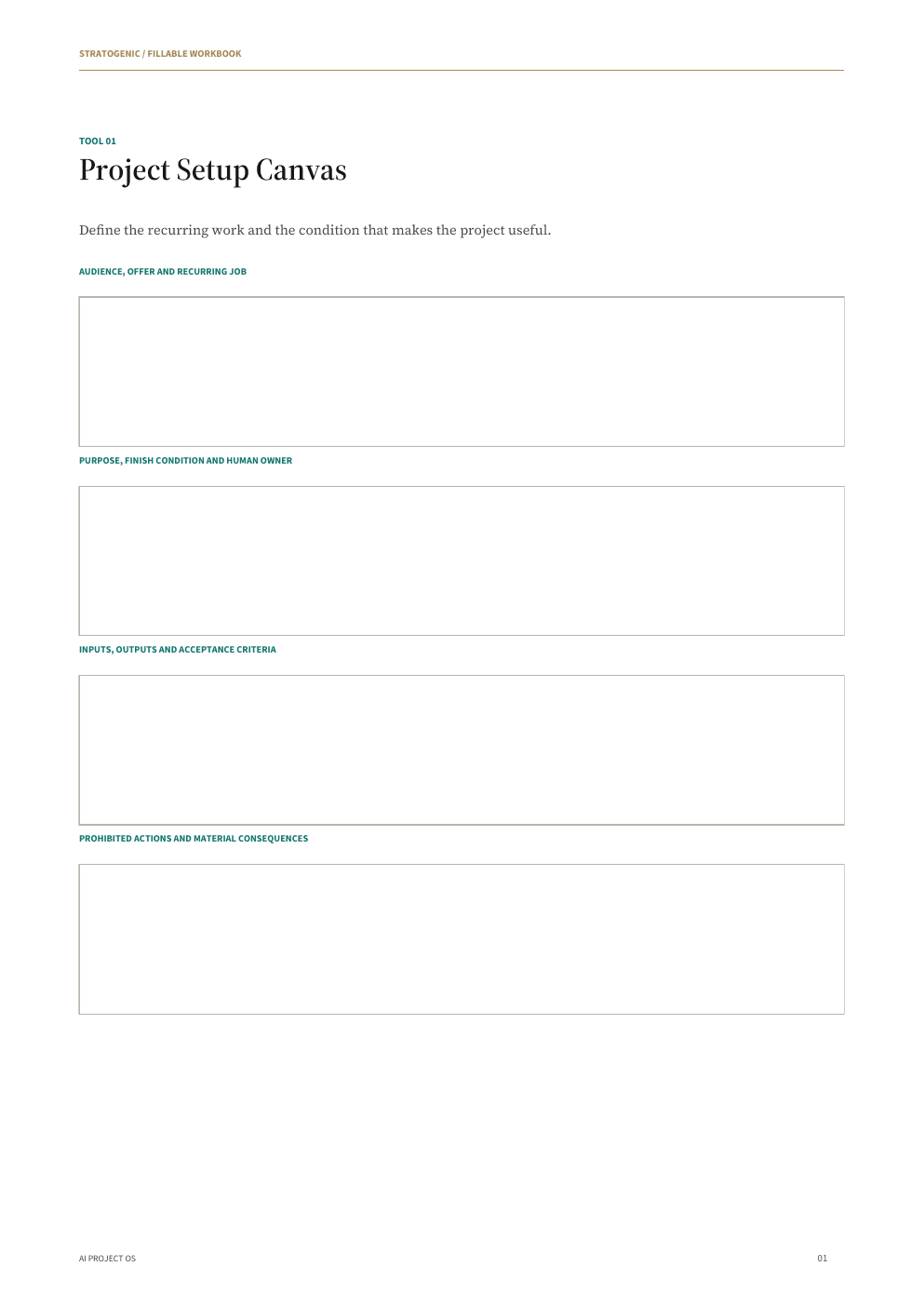
Two-page quick-start, practitioner guide, fillable workbook, twelve project-and-connector recipes, editable project starter, populated Mara implementation, evidence and permission registers, Claude and ChatGPT adapters, and offline health check.
What It Is For
One maintained AI project that produces review-ready recurring assets from approved sources without receiving unsupervised publishing or sending authority.
Intended for: Solo operators and small teams with a real offer who repeatedly create discovery content, lead magnets, email sequences, calls to action and sales-page updates in Claude or ChatGPT.
What Exists Behind This Page
This preview is tied to the built edition and its recorded release state. It is not a promise that the product is already available or that using it guarantees the outcome.
- Validated 24-page practitioner guide and two-page quick-start
- 44 fillable workbook fields
- 19 named sources with transfer limits
- 10 working tools, 3 worked examples and 12 bounded recipes
- Portable project starter, two provider adapters, small-project recipe template and offline health check
- Three previews rendered from customer pages
- 2 prepared editions
- 3 inspectable customer-page previews
- 19 named sources with stated use and transfer limits
Claims boundary: This product supports a maintained, human-reviewed AI workspace. It does not promise rankings, conversion, sales, passive income or reliable model memory. It does not certify a provider, connector or workflow as secure or compliant. A named person remains accountable for sources, permissions, claims, publishing, sending, customer data and stop decisions.
Three Decisions It Helps You Make
- 01
Which sources and claims are authoritative now?
- 02
Can a fresh project chat reproduce one acceptable result without hidden context?
- 03
What evidence would make us continue, reshape, pause or stop?
Price and Package
What this edition does not promise
- This product supports a maintained, human-reviewed AI workspace. It does not promise rankings, conversion, sales, passive income or reliable model memory. It does not certify a provider, connector or workflow as secure or compliant. A named person remains accountable for sources, permissions, claims, publishing, sending, customer data and stop decisions.
- A working aid, not a guarantee of a commercial, career or personal outcome.
- It does not replace legal, regulatory, clinical, financial or employer-specific advice.
- Human release review and fulfilment testing remain required.
Source Corpus Acknowledged
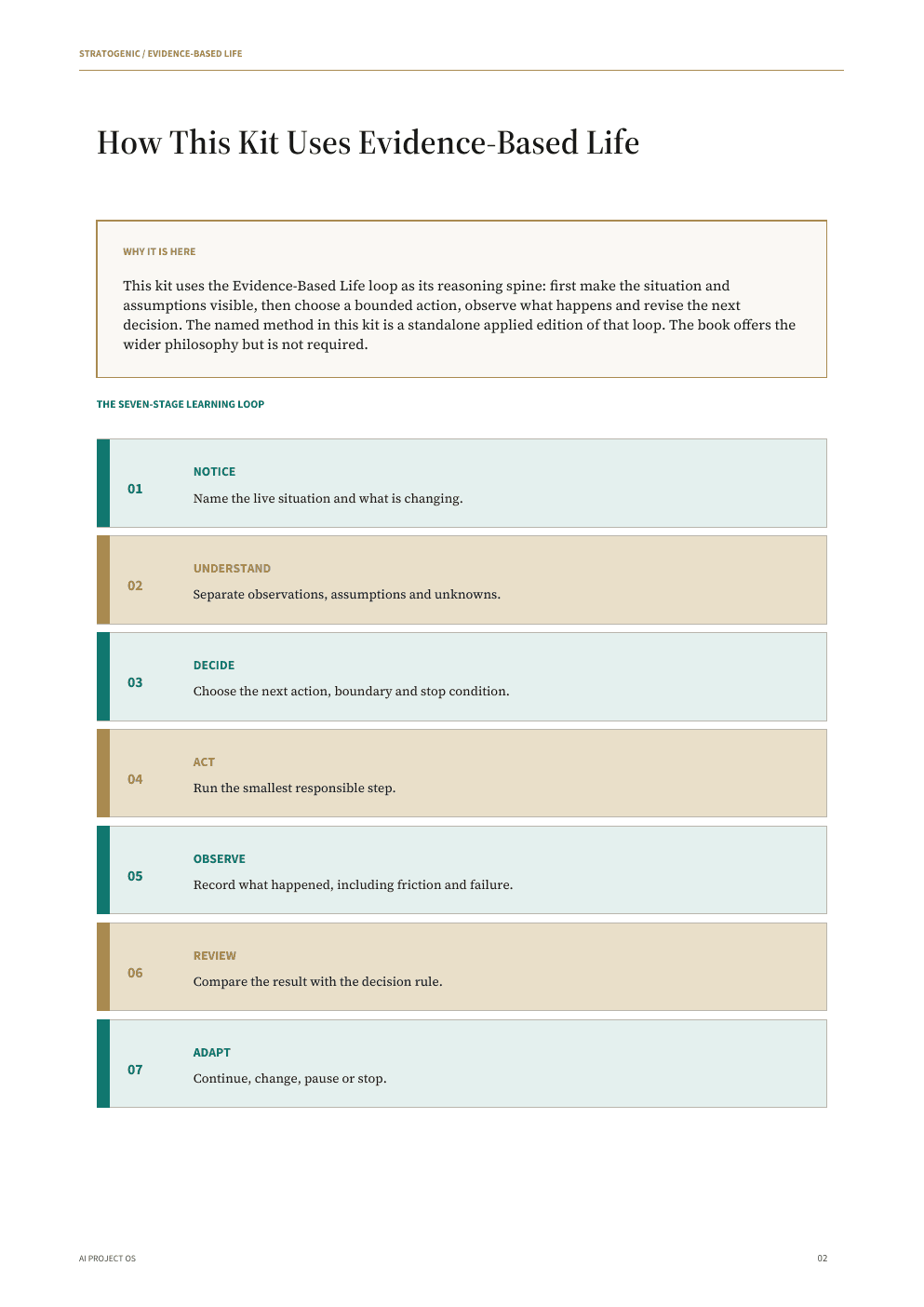
The method inherits the complete Evidence-Based Life learning loop and acknowledges current OpenAI and Anthropic project, app, connector and scheduling documentation, provider context guidance, NIST, OECD and OWASP material, and official UK and US marketing guidance. Provider documents inform replaceable setup adapters and recipes; none independently validates or endorses this product.
19 named sources and transfer limits
- OpenAI, Projects in ChatGPT. — Describe current ChatGPT Project files, project instructions, memory choices, sharing and app-source behaviour for the replaceable ChatGPT adapter. Limit: Provider documentation describes a changing product surface. It does not validate the Project Authority method, guarantee recall or establish that a connected app is suitable. Recheck every step at release.
- Anthropic, What are projects? — Describe current Claude.ai Project knowledge, instructions, plan boundaries and collaboration for the replaceable Claude adapter. Limit: Provider documentation describes a changing product surface. It does not validate the Project Authority method, guarantee retrieval quality or endorse this product. Recheck every step at release.
- Anthropic, Cowork: Organize work with projects. — Keep local Cowork projects distinct from Claude.ai Projects and identify where folders, links, instructions and project memory differ. Limit: Cowork behaviour, availability and terminology can change. This source does not make Claude.ai, Claude Code and Cowork interchangeable.
- OpenAI, Scheduled tasks. — Define the current recurring-task route: web tasks may use uploaded files, connected tools, skills and plugins available to the chat; durable instructions still belong in the task prompt or an attached skill. Limit: Availability, app events, connected tools, limits and local-file behaviour vary by plan, workspace, surface and release. This does not validate any recipe or guarantee unattended execution.
- OpenAI, Apps in ChatGPT. — Describe current app connections, administrator controls, action permissions and the custom MCP route for the replaceable ChatGPT recipes. Limit: App availability and controls change. A listed or approved app is not independent evidence that it is suitable, secure or necessary for a user's task.
- Anthropic, Schedule recurring tasks in Claude Cowork. — Define the current Claude route for scheduled briefings, connector-enabled reports, approval mode and task review. Limit: Cowork, plan access, connector behaviour and scheduling options change. Provider examples do not prove that a recipe is useful or safe for a particular account.
- Anthropic, Use Google Workspace connectors. — Describe current Gmail, Calendar and Drive capabilities and approval behaviour for the bounded recipe examples. Limit: The connector can expose sensitive information and may support write actions. The recipe's narrower permission ceiling must be tested against the live account and workspace.
- OWASP, MCP Tool Poisoning. — Require untrusted-instruction testing, server review and least-privilege separation before a custom MCP route is used. Limit: The page describes an attack class and mitigations; it does not certify a particular connector, MCP server or host implementation.
- Anthropic, Effective context engineering for AI agents. — Treat prompts, tools, retrieved data and message history as an actively curated context system. Limit: The terminology and techniques are provider guidance and may not transfer unchanged across systems.
- OpenAI, Prompt engineering. — Connect instructions, context, examples and evaluation to a specific model-assisted task. Limit: Provider guidance is product-specific, changes over time and is not independent evidence of reliability.
- OpenAI, Working with evals. — Treat evaluation criteria, representative data and repeatable runs as part of AI product development. Limit: An evaluation measures its chosen cases and graders; it cannot establish universal fitness or safety.
- NIST AI Risk Management Framework 1.0. — Structure governance, mapping, measurement and management questions. Limit: The framework is voluntary and contextual; using it does not certify a system.
- NIST AI 600-1, Generative Artificial Intelligence Profile. — Identify generative-AI risks, measurement needs and lifecycle controls. Limit: A profile supports risk work; it does not make a use case safe.
- OECD AI Principles. — Keep human-centred values, transparency, robustness and accountability visible. Limit: Principles require contextual implementation and are not a technical test suite.
- OWASP, GenAI LLM Top 10 2026. — Ground permission, approval and containment design in named, ranked LLM application risks rather than a generic sense of caution. Limit: A rankings guide reflects reported incident patterns at time of publication (August 2026); it does not certify a specific system as secure.
- ICO, Direct marketing using electronic mail. — Require a lawful outreach basis, clear identity, opt-out route and suppression record before using email or message campaigns. Limit: The applicable UK GDPR and PECR position depends on channel, recipient and circumstances; this is not legal advice.
- Federal Trade Commission, CAN-SPAM Act: A Compliance Guide for Business. — Provide a US commercial-email route covering accurate headers, non-deceptive subjects, identification, address and opt-out handling. Limit: CAN-SPAM does not resolve every privacy, state-law, platform or non-email outreach obligation.
- ASA and CAP, Misleading advertising. — Keep material information visible and require substantiation for objective product, income and performance claims. Limit: CAP advice is not legal advice and claim assessment depends on the advertisement's overall impression and context.
- Federal Trade Commission, Advertising FAQs: A Guide for Small Business. — Require a reasonable evidential basis for express and implied advertising claims and make qualifications clear and conspicuous. Limit: Federal guidance is context-dependent and does not replace applicable state law or qualified legal advice.
Corpus review: 2026-09-05. Provider documentation is operational guidance, not independent validation or endorsement.
Frequently Asked Questions
What is AI Project Operating System?
AI Project Operating System is ai project operating system designed to help solo operators and small teams with a real offer who repeatedly create discovery content, lead magnets, email sequences, calls to action and sales-page updates in claude or chatgpt. one maintained AI project that produces review-ready recurring assets from approved sources without receiving unsupervised publishing or sending authority.
What do I receive with AI Project Operating System?
Two-page quick-start, practitioner guide, fillable workbook, twelve project-and-connector recipes, editable project starter, populated Mara implementation, evidence and permission registers, Claude and ChatGPT adapters, and offline health check.
Can I buy or download AI Project Operating System now?
No. This is a forthcoming preview. Checkout and delivery stay disabled until named human approval and fulfilment checks are recorded.