Take a Look Inside
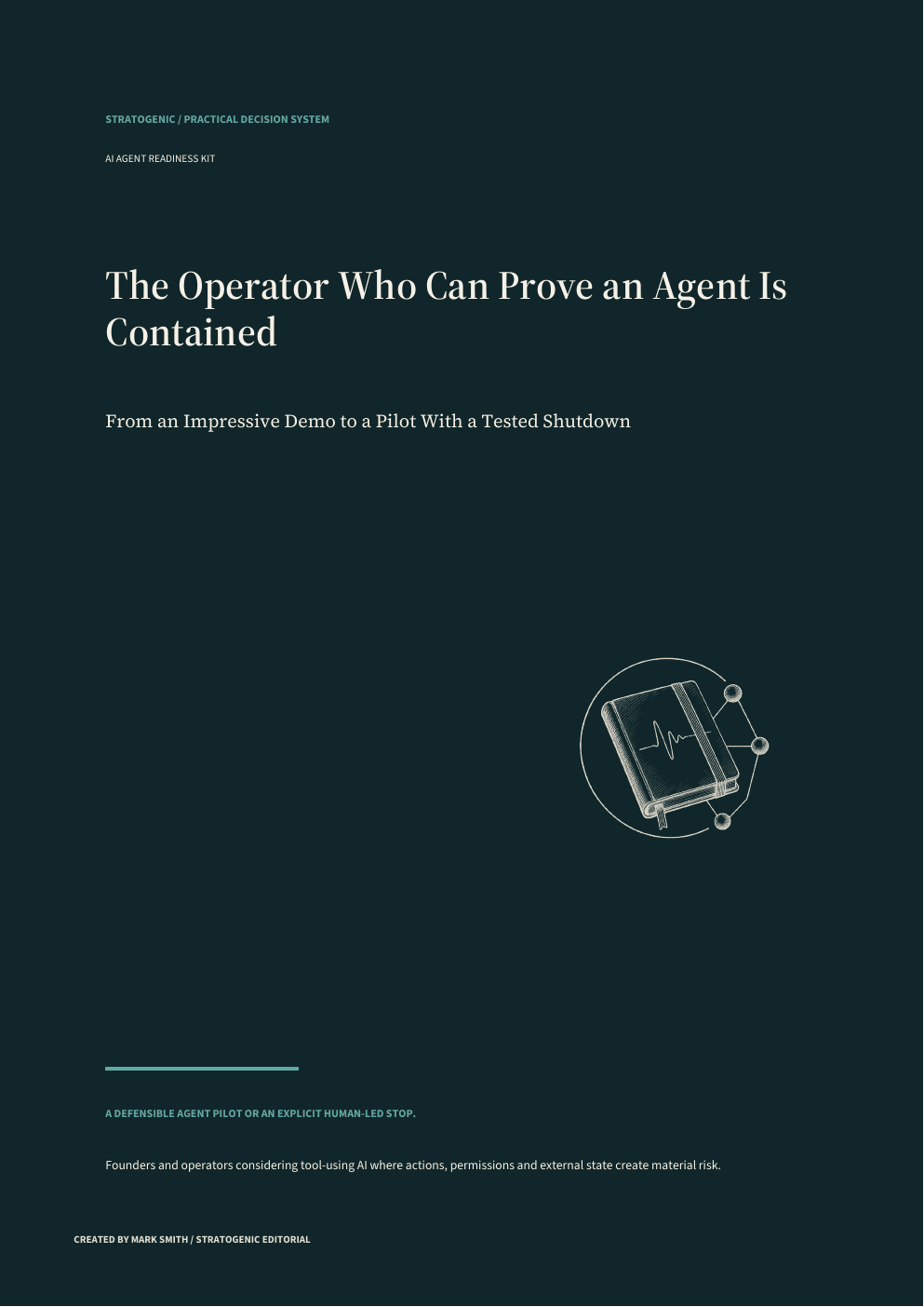
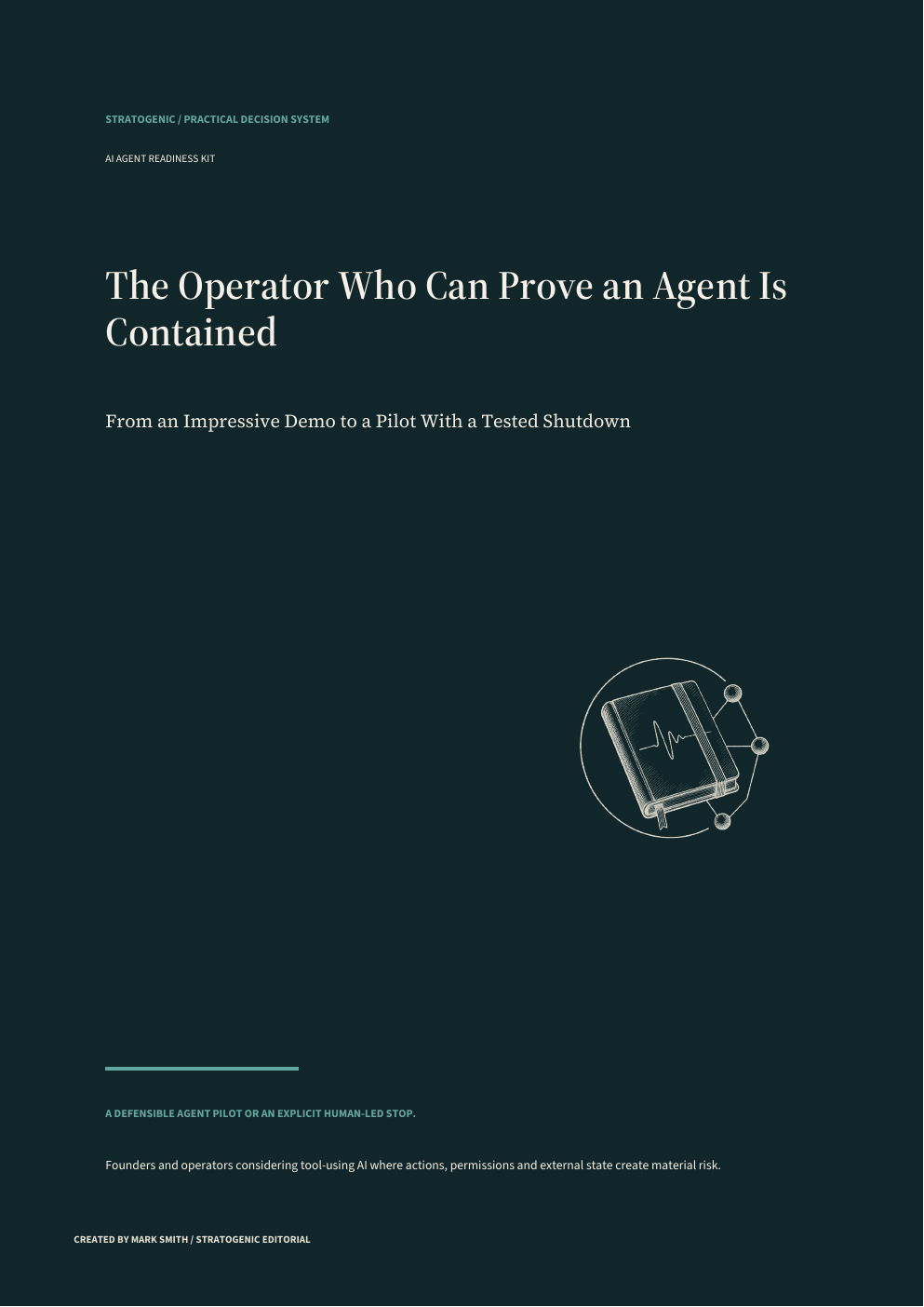
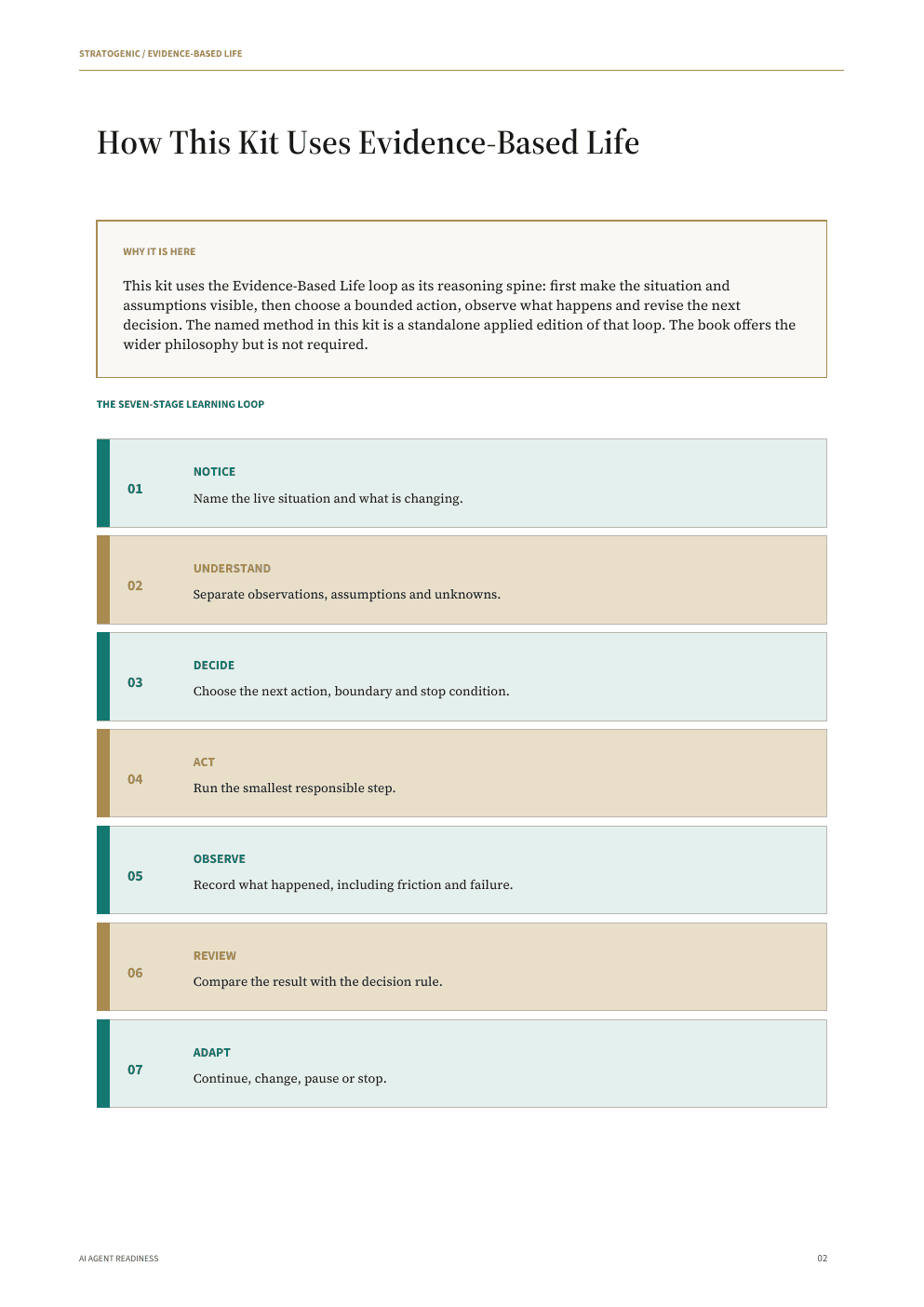
Open a focused preview of the supplied pages, sheets or working views.
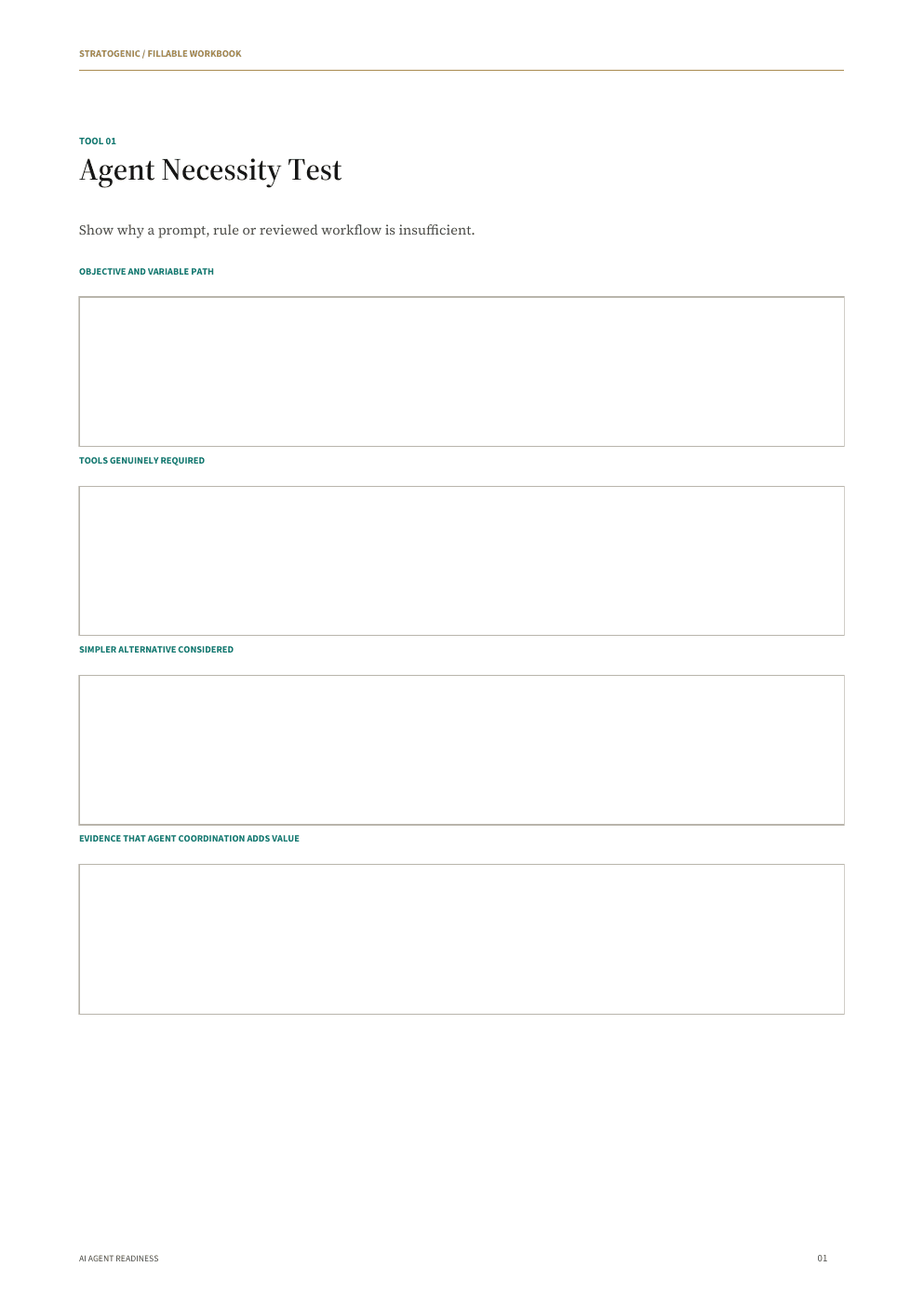
PDF guide, fillable PDF workbook, editable Markdown tools, JSON tools and evidence
What It Is For
A defensible agent pilot or an explicit human-led stop.
Intended for: Founders and operators considering tool-using AI where actions, permissions and external state create material risk.
What Exists Behind This Page
This preview is tied to the built edition and its recorded release state. It is not a promise that the product is already available or that using it guarantees the outcome.
- Validated practitioner guide
- 32 fillable workbook fields
- 14 named sources with transfer limits
- 7 working tools and 2 worked examples
- three previews rendered from customer pages
- 2 prepared editions
- 3 inspectable customer-page previews
- 17 named sources with stated use and transfer limits
Claims boundary: This product supports small, controlled AI experiments and operating decisions. It does not certify a model, vendor, workflow or agent as safe. A named person remains accountable for permissions, data, review, material actions and stop decisions.
Three Decisions It Helps You Make
- 01
Does the work require variable tool choice, and can every consequential action remain bounded and reviewable?
- 02
Is the consequence or uncertainty high enough that the work should remain human-led?
- 03
Which live situation makes AI Agent Readiness Kit the smallest useful edition rather than a larger system?
Price and Package
What this edition does not promise
- This product supports small, controlled AI experiments and operating decisions. It does not certify a model, vendor, workflow or agent as safe. A named person remains accountable for permissions, data, review, material actions and stop decisions.
- A working aid, not a guarantee of a commercial, career or personal outcome.
- It does not replace legal, regulatory, clinical, financial or employer-specific advice.
- Human release review and fulfilment testing remain required.
Source Corpus Acknowledged
The method draws on agent guidance from OpenAI and Anthropic; risk and standards material from NIST, OECD and OWASP; independent agent research; and the EU AI Act corpus. This includes NIST's 2026 AI Agent Standards Initiative and OWASP's Agentic Applications and GenAI LLM Top 10s. No named source endorses this product or establishes that an agent is safe.
17 named sources and transfer limits
- OpenAI, Agents SDK guide. — Acknowledge current provider patterns for tools, handoffs, traces and agent orchestration. Limit: An SDK architecture is not a governance framework, safety certification or reason to deploy an agent.
- OpenAI, Working with evals. — Treat evaluation criteria, representative data and repeatable runs as part of AI product development. Limit: An evaluation measures its chosen cases and graders; it cannot establish universal fitness or safety.
- Anthropic, Building effective agents. — Distinguish predefined workflows from agents that dynamically direct their process and tool use. Limit: Provider experience is useful design input, not independent proof that an agent is suitable.
- Anthropic, Effective context engineering for AI agents. — Treat prompts, tools, retrieved data and message history as an actively curated context system. Limit: The terminology and techniques are provider guidance and may not transfer unchanged across systems.
- Anthropic, Demystifying evals for AI agents. — Evaluate multi-step behaviour, tool use, state changes and outcomes rather than only the final answer. Limit: Evaluation advice does not remove the need for use-case-specific controls and independent review.
- NIST AI Risk Management Framework 1.0. — Structure governance, mapping, measurement and management questions. Limit: The framework is voluntary and contextual; using it does not certify a system.
- NIST AI 600-1, Generative Artificial Intelligence Profile. — Identify generative-AI risks, measurement needs and lifecycle controls. Limit: A profile supports risk work; it does not make a use case safe.
- OECD AI Principles. — Keep human-centred values, transparency, robustness and accountability visible. Limit: Principles require contextual implementation and are not a technical test suite.
- MIT AI Agent Index. — Keep agent capability, deployment and safety claims inspectable. Limit: Coverage is selective and time-bounded; absence or inclusion is not certification.
- OWASP, Top 10 for Agentic Applications for 2026. — Prompt explicit controls for tools, memory, identity, permissions and cascading failures. Limit: Threat guidance does not replace a system-specific security review.
- Mitchell et al. (2019), Model Cards for Model Reporting. — Record intended use, evaluation context, limitations and performance evidence. Limit: Documentation quality does not establish fitness for a new use case.
- Morris et al. (2023), Levels of AGI. — Distinguish performance, generality and autonomy when evaluating AGI claims. Limit: A proposed taxonomy is not a consensus definition or evidence that AGI has arrived.
- Regulation (EU) 2024/1689, Artificial Intelligence Act. — Keep provider, deployer, risk, transparency and human-oversight questions visible where EU scope may apply. Limit: Classification and obligations are context-dependent; this product is not legal advice.
- European Commission, AI Act regulatory framework. — Prompt a current implementation and application-date check rather than relying on remembered summaries. Limit: Implementation material changes; users must verify the current official position and their role.
- OWASP, GenAI LLM Top 10 2026. — Ground permission, approval and containment design in named, ranked LLM application risks rather than a generic sense of caution. Limit: A rankings guide reflects reported incident patterns at time of publication (August 2026); it does not certify a specific system as secure.
- NIST Center for AI Standards and Innovation, AI Agent Standards Initiative. — Treat agent interoperability and security standards as an active, developing area rather than a settled one. Limit: The initiative launched February 2026 and its agentic risk-management profile (AI 100-5) was still in development at time of writing; recheck publication status before citing it as final.
- OECD (2026), Benefits of AI openness. — Account for teams that use both closed and self-hosted open-weight models for cost, data-residency or fine-tuning reasons. Apply the same permission, logging and legal checks regardless of model type. Limit: The report provides economic and policy analysis, not product-specific security, legal or deployment approval. Its workload assumptions, costs and model comparisons must be checked for the live use case.
Corpus review: 2026-09-05. Provider documentation is operational guidance, not independent validation or endorsement.
Frequently Asked Questions
What is AI Agent Readiness Kit?
AI Agent Readiness Kit is ai operating system designed to help founders and operators considering tool-using ai where actions, permissions and external state create material risk. a defensible agent pilot or an explicit human-led stop.
What do I receive with AI Agent Readiness Kit?
PDF guide, fillable PDF workbook, editable Markdown tools, JSON tools and evidence
Can I buy or download AI Agent Readiness Kit now?
No. This is a forthcoming preview. Checkout and delivery stay disabled until named human approval and fulfilment checks are recorded.